Can Stage 2B Lung Cancer Go Into Remission? Symptoms, Treatment Options, and Survival Outlook
Lung cancer remains one of the most common and serious cancers worldwide, affecting millions of people every year. Among the different stages of the disease, stage 2B lung cancer represents a point where the cancer has grown larger or spread to nearby lymph nodes but has not yet reached distant organs. Understandably, many patients and families ask an important question: Can stage 2B lung cancer go into remission?
The answer is encouraging for many patients. With early detection, appropriate treatment, and continuous medical care, remission is possible in some cases. Advances in surgery, chemotherapy, immunotherapy, and targeted therapies have significantly improved outcomes for people diagnosed at this stage. This article explores the condition in detail, including symptoms, diagnosis, treatment strategies, prognosis, and supportive care options.
Overview
Stage 2B lung cancer is classified as part of non-metastatic lung cancer, meaning the cancer has not spread to distant organs such as the brain, liver, or bones. At this stage, the tumor may be larger or may have spread to nearby lymph nodes within the lung.
The main question many patients ask is: Can stage 2B lung cancer go into remission? Remission means that signs and symptoms of cancer are reduced or disappear after treatment. While remission does not always mean the cancer is permanently cured, it can indicate successful treatment and long-term disease control.
Doctors typically determine stage 2B using the TNM staging system, which evaluates tumor size, lymph node involvement, and metastasis.
Stage 2B Lung Cancer Characteristics
| Feature | Description |
|---|---|
| Tumor Size | Often between 4–7 cm or larger |
| Lymph Node Involvement | May spread to nearby lymph nodes |
| Distant Spread | No distant metastasis |
| Treatment Approach | Surgery, chemotherapy, targeted therapy, or immunotherapy |
Early and aggressive treatment increases the likelihood of remission.
Types of Lung Cancer
Stage 2B lung cancer may occur in different types of lung cancer. The treatment plan often depends on the specific type.
1. Non-Small Cell Lung Cancer (NSCLC)
This is the most common form, accounting for about 85% of lung cancer cases. Subtypes include:
| Subtype | Description |
|---|---|
| Adenocarcinoma | Common in non-smokers; begins in mucus-producing cells |
| Squamous Cell Carcinoma | Usually linked to smoking |
| Large Cell Carcinoma | Fast-growing and aggressive |
2. Small Cell Lung Cancer (SCLC)
Small cell lung cancer grows more quickly and spreads faster. However, stage 2B classification is more commonly associated with non-small cell lung cancer.
Causes and Risk Factors
Lung cancer develops due to genetic mutations in lung cells that cause uncontrolled growth. Several risk factors increase the likelihood of developing stage 2B lung cancer.
Major Risk Factors
| Risk Factor | Explanation |
|---|---|
| Smoking | Responsible for most lung cancer cases |
| Secondhand Smoke | Increases risk for non-smokers |
| Radon Gas Exposure | A radioactive gas found in soil and buildings |
| Air Pollution | Long-term exposure increases risk |
| Family History | Genetics may play a role |
| Occupational Exposure | Asbestos, arsenic, diesel fumes |
While not all patients with these risk factors develop lung cancer, they significantly increase the chances.
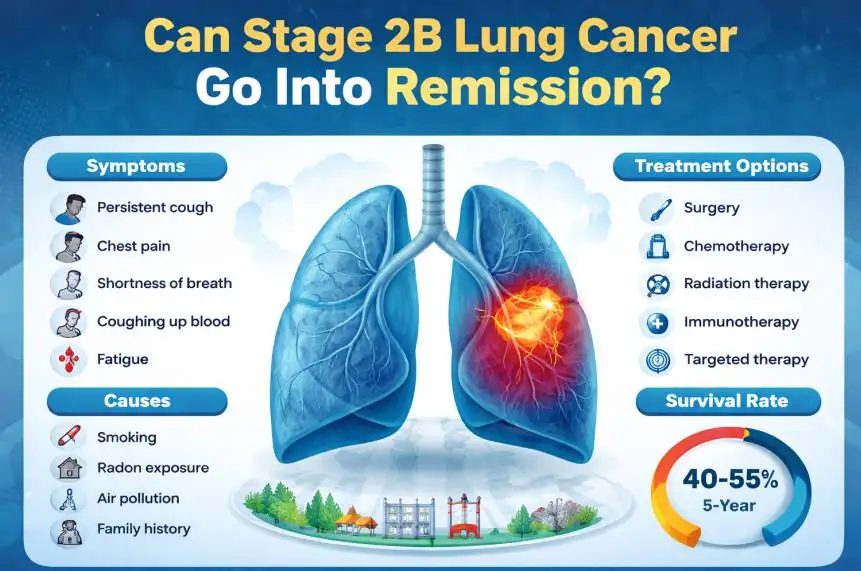
Symptoms and Early Warning Signs
Stage 2B lung cancer symptoms can vary depending on tumor location and size. Some patients may notice clear signs, while others experience mild symptoms.
Common Symptoms
| Symptom | Description |
|---|---|
| Persistent cough | Often worsens over time |
| Chest pain | Especially during deep breathing or coughing |
| Shortness of breath | Due to airway blockage |
| Coughing up blood | A serious warning sign |
| Fatigue | Caused by the body fighting cancer |
| Unexplained weight loss | Often occurs in cancer patients |
Early recognition of these symptoms can lead to earlier diagnosis and improved outcomes.
Diagnosis
Doctors use several tests to diagnose and stage lung cancer accurately.
Common Diagnostic Methods
| Test | Purpose |
|---|---|
| Chest X-ray | Initial detection of abnormalities |
| CT Scan | Detailed imaging of lungs |
| PET Scan | Detects cancer activity in the body |
| Biopsy | Confirms presence of cancer cells |
| Bronchoscopy | Examines airways and collects tissue samples |
Accurate staging is crucial to determine the best treatment strategy.
Treatment Options
Treatment for stage 2B lung cancer typically involves a combination of therapies aimed at removing or destroying cancer cells.
1. Surgery
Surgery is often the first treatment when the tumor can be removed.
Types of surgery include:
| Procedure | Description |
|---|---|
| Lobectomy | Removal of one lung lobe |
| Pneumonectomy | Removal of an entire lung |
| Segmentectomy | Removal of part of a lung lobe |
2. Chemotherapy
Chemotherapy uses drugs to kill cancer cells and may be given before or after surgery.
3. Radiation Therapy
Radiation targets cancer cells with high-energy beams and may be used when surgery is not possible.
4. Immunotherapy
Immunotherapy helps the immune system recognize and attack cancer cells. This approach has improved remission rates in recent years.
5. Targeted Therapy
Targeted drugs attack specific genetic mutations found in certain lung cancers.
Combining these treatments can improve outcomes and increase the chances of remission.
Prevention and Lifestyle Recommendations
While not all lung cancers can be prevented, lifestyle changes can significantly reduce risk.
Prevention Strategies
| Strategy | Benefit |
|---|---|
| Quit smoking | Most effective prevention method |
| Avoid secondhand smoke | Reduces exposure to carcinogens |
| Test homes for radon | Prevents long-term exposure |
| Healthy diet | Supports immune function |
| Regular exercise | Improves overall health |
| Routine screenings | Detects cancer earlier |
People with high risk factors should discuss lung cancer screening with their doctor.
Prognosis and Survival Rates
The prognosis for stage 2B lung cancer depends on several factors, including overall health, treatment response, and tumor biology.
Survival Statistics
| Stage | Estimated 5-Year Survival Rate |
|---|---|
| Stage 2A | Around 60% |
| Stage 2B | Around 40–55% |
| Stage 3 | Lower survival rates due to spread |
Many patients ask again: Can stage 2B lung cancer go into remission?
Yes, remission is possible. Patients who undergo successful surgery combined with chemotherapy or immunotherapy often achieve partial or complete remission, especially when the cancer is detected early and treated aggressively.
Latest Research and Innovations
Medical research continues to improve outcomes for lung cancer patients.
Emerging Advances
| Innovation | Description |
|---|---|
| Personalized medicine | Treatments tailored to genetic mutations |
| Advanced immunotherapy | Boosts immune response against tumors |
| AI-assisted diagnosis | Improves early detection |
| Minimally invasive surgery | Faster recovery times |
| Liquid biopsy | Detects cancer through blood tests |
These innovations are giving hope to patients diagnosed with stage 2B lung cancer.
Coping and Support for Patients
A lung cancer diagnosis can be emotionally overwhelming. Patients often experience anxiety, fear, and uncertainty about the future.
Support Strategies
| Support Type | Benefit |
|---|---|
| Counseling | Helps manage emotional stress |
| Support groups | Connects patients with others facing similar challenges |
| Nutrition therapy | Improves treatment tolerance |
| Physical rehabilitation | Helps maintain strength |
| Family involvement | Provides emotional stability |
Strong support systems can greatly improve quality of life during treatment.
Conclusion
Stage 2B lung cancer represents a serious but potentially treatable stage of lung cancer. With modern medical advances, many patients receive effective treatment that significantly reduces cancer activity. For those wondering, can stage 2B lung cancer go into remission, the answer is yes in some cases, particularly when the disease is treated early with a combination of surgery, chemotherapy, and newer therapies such as immunotherapy.
While remission does not always mean a permanent cure, it can provide years of disease-free living and improved quality of life. Continued research and medical innovation are steadily improving survival rates and offering new hope for patients diagnosed with this condition.
FAQ
1. Can stage 2B lung cancer be cured?
In some cases, stage 2B lung cancer can be cured, especially if the tumor is removed surgically and followed by additional treatments like chemotherapy or radiation.
2. What is the survival rate for stage 2B lung cancer?
The estimated five-year survival rate for stage 2B lung cancer is roughly 40–55%, depending on treatment response and overall health.
3. How long can someone live with stage 2B lung cancer?
Many patients live several years after diagnosis, particularly if the cancer responds well to treatment.
4. Is surgery always required for stage 2B lung cancer?
Surgery is commonly recommended when the tumor is operable, but some patients may receive chemotherapy, radiation, or immunotherapy instead.
5. Can lung cancer return after remission?
Yes, lung cancer can recur even after remission. This is why ongoing monitoring and follow-up scans are essential after treatment.