Stage 1 Cervical Cancer Treatment: Early Detection, Effective Options, and Recovery Guide
Stage 1 cervical cancer treatment offers one of the best chances for successful recovery because the cancer is still confined to the cervix. When detected at this early stage, treatment can often remove or destroy cancer cells before they spread to nearby tissues or other organs. Thanks to modern medical advances, many patients diagnosed with stage 1 cervical cancer can achieve excellent long-term outcomes.
Understanding treatment options, symptoms, diagnosis, and prevention strategies can empower patients and their families to make informed decisions. This guide explains everything you need to know about stage 1 cervical cancer treatment, including available therapies, survival rates, lifestyle recommendations, and the latest research developments.
Overview
Stage 1 cervical cancer occurs when cancer cells are found only in the cervix and have not spread beyond it. At this stage, treatment is usually highly effective, and doctors focus on eliminating the tumor while preserving as much normal tissue as possible.
Stage 1 cervical cancer is typically divided into smaller categories based on tumor size and depth of invasion. These sub-stages help doctors determine the most appropriate treatment plan.
Stage 1 Cervical Cancer Classification
| Substage | Description |
|---|---|
| Stage 1A | Microscopic cancer only visible under a microscope |
| Stage 1A1 | Very small tumor with minimal invasion |
| Stage 1A2 | Slightly deeper invasion but still microscopic |
| Stage 1B | Tumor visible to the naked eye but still confined to the cervix |
| Stage 1B1 | Tumor smaller than 4 cm |
| Stage 1B2 | Tumor larger than 4 cm |
The earlier the cancer is diagnosed, the more treatment options become available.
Types
Several types of cervical cancer may appear in stage 1, and identifying the type helps determine the best stage 1 cervical cancer treatment plan.
Main Types of Cervical Cancer
| Type | Description |
|---|---|
| Squamous Cell Carcinoma | Most common type, begins in thin cells lining the cervix |
| Adenocarcinoma | Starts in glandular cells that produce mucus |
| Adenosquamous Carcinoma | Contains features of both squamous and glandular cells |
| Rare Types | Includes small cell carcinoma and neuroendocrine tumors |
Squamous cell carcinoma accounts for approximately 70–80% of cervical cancer cases worldwide.
Causes and Risk Factors
The primary cause of cervical cancer is persistent infection with high-risk strains of the Human Papillomavirus (HPV). However, several additional factors can increase the risk.
Common Causes and Risk Factors
| Risk Factor | Explanation |
|---|---|
| HPV Infection | Responsible for nearly all cervical cancer cases |
| Early sexual activity | Increases exposure to HPV |
| Multiple sexual partners | Higher likelihood of HPV infection |
| Smoking | Weakens the immune system |
| Weak immune system | Reduces ability to fight HPV |
| Long-term birth control use | Slightly increases risk |
| Lack of regular screening | Delays detection |
HPV types 16 and 18 are responsible for the majority of cervical cancer cases.
Symptoms and Early Warning Signs
In many cases, stage 1 cervical cancer may not produce obvious symptoms. This is why routine screening is extremely important.
Possible Early Symptoms
| Symptom | Description |
|---|---|
| Abnormal vaginal bleeding | Between periods, after intercourse, or after menopause |
| Unusual vaginal discharge | Watery, bloody, or foul-smelling |
| Pelvic pain | Persistent discomfort in the lower abdomen |
| Pain during intercourse | Discomfort or pain during sexual activity |
| Heavier or longer menstrual periods | Changes in menstrual patterns |
Any persistent or unusual symptoms should be evaluated by a healthcare provider.
Diagnosis
Accurate diagnosis is essential to determine the correct stage 1 cervical cancer treatment strategy.
Common Diagnostic Tests
| Test | Purpose |
|---|---|
| Pap smear | Detects abnormal cervical cells |
| HPV test | Identifies high-risk HPV strains |
| Colposcopy | Detailed examination of the cervix |
| Biopsy | Confirms presence of cancer cells |
| Imaging tests | MRI, CT scan, or PET scan to evaluate tumor size |
Early diagnosis significantly improves treatment success.
Treatment Options
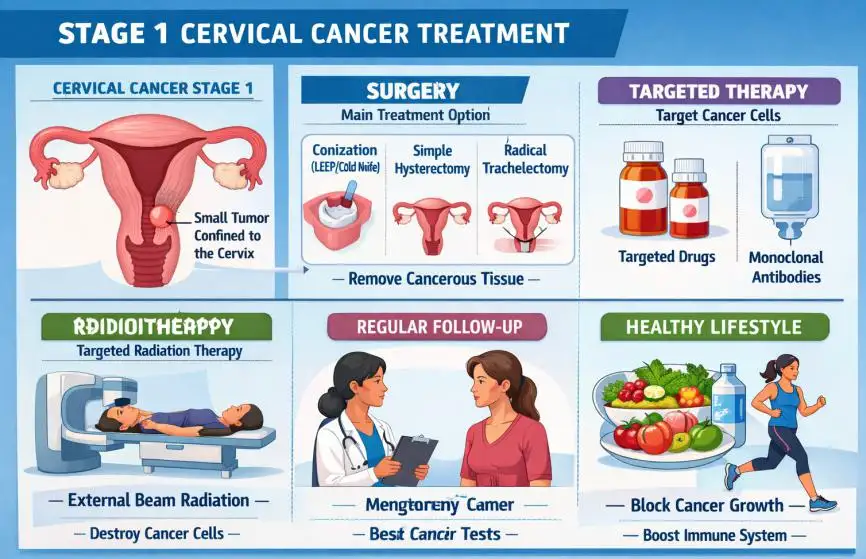
Stage 1 cervical cancer treatment typically involves surgery, radiation therapy, or a combination of both. The choice depends on tumor size, patient age, and fertility considerations.
Main Treatment Methods
| Treatment | Description |
|---|---|
| Conization | Removal of a cone-shaped section of cervical tissue |
| Simple hysterectomy | Removal of the uterus and cervix |
| Radical hysterectomy | Removal of uterus, cervix, and surrounding tissues |
| Trachelectomy | Removal of the cervix while preserving fertility |
| Radiation therapy | High-energy radiation destroys cancer cells |
| Chemotherapy | Sometimes combined with radiation in certain cases |
Treatment Based on Substage
| Substage | Common Treatment |
|---|---|
| Stage 1A1 | Conization or simple hysterectomy |
| Stage 1A2 | Radical hysterectomy or trachelectomy |
| Stage 1B1 | Radical hysterectomy or radiation |
| Stage 1B2 | Surgery plus possible radiation or chemotherapy |
Fertility-preserving treatments may be available for younger patients.
Prevention and Lifestyle Recommendations
Although cervical cancer cannot always be prevented, several strategies can greatly reduce risk.
Prevention Tips
| Strategy | Benefit |
|---|---|
| HPV vaccination | Protects against high-risk HPV strains |
| Regular Pap smears | Detects abnormal cells early |
| Safe sexual practices | Reduces HPV exposure |
| Quit smoking | Strengthens immune response |
| Healthy diet | Supports overall immune health |
| Routine gynecological exams | Enables early detection |
Preventive screening remains one of the most effective tools in reducing cervical cancer incidence.
Prognosis and Survival Rates
Stage 1 cervical cancer treatment has a very favorable prognosis compared to later stages.
5-Year Survival Rates
| Stage | Survival Rate |
|---|---|
| Stage 1A | 95–98% |
| Stage 1B | 80–90% |
Survival outcomes depend on factors such as tumor size, treatment response, and overall health.
Early treatment dramatically improves the likelihood of complete recovery.
Latest Research and Innovations
Medical research continues to improve stage 1 cervical cancer treatment through new technologies and therapies.
Recent Advances
| Innovation | Description |
|---|---|
| Minimally invasive surgery | Faster recovery and fewer complications |
| Robotic-assisted surgery | Greater surgical precision |
| Targeted therapy | Drugs that attack specific cancer cells |
| Immunotherapy | Stimulates the immune system to fight cancer |
| AI-assisted screening | Improves early detection accuracy |
These innovations aim to increase treatment success while reducing side effects.
Coping and Support for Patients
A cervical cancer diagnosis can be emotionally challenging, but support systems can make a significant difference.
Helpful Support Resources
| Support Method | Benefit |
|---|---|
| Counseling | Helps manage anxiety and stress |
| Cancer support groups | Provides shared experiences and encouragement |
| Nutrition counseling | Maintains strength during treatment |
| Physical therapy | Supports recovery after surgery |
| Family and community support | Provides emotional stability |
Patients who receive strong support often cope better during treatment and recovery.
Conclusion
Stage 1 cervical cancer treatment offers a high chance of successful recovery when the disease is detected early. With modern surgical techniques, advanced therapies, and improved screening methods, many patients can achieve long-term remission and maintain a good quality of life.
Understanding the causes, symptoms, diagnosis, and available treatment options allows patients to take proactive steps toward their health. Regular screenings, HPV vaccination, and healthy lifestyle choices remain essential tools for prevention and early detection.
FAQ
1. Can stage 1 cervical cancer be cured?
Yes. When detected early, stage 1 cervical cancer treatment has very high cure rates, especially when treated promptly.
2. What is the best treatment for stage 1 cervical cancer?
The most common treatments include surgery such as hysterectomy or trachelectomy, depending on tumor size and fertility considerations.
3. Can women still have children after treatment?
In some cases, fertility-preserving procedures like trachelectomy allow women to have children after treatment.
4. How long does recovery take after treatment?
Recovery varies depending on treatment type but usually ranges from several weeks to a few months.
5. Is radiation always necessary for stage 1 cervical cancer?
Not always. Many early cases can be successfully treated with surgery alone.
6. How often should cervical cancer screening be done?
Most experts recommend Pap smear screening every 3 years or HPV testing every 5 years, depending on age and health guidelines.